Are female leaders more efficient in family firms than in non-family firms?
Per-Olof Bjuggren; Louise Nordström; Johanna Palmberg
Audio > Play / StopSwedish data shows women in combined CEO-owner-board roles drive higher profitability in family firms
Women remain scarce in business leadership, but when they hold combined CEO, board, and ownership roles in family firms, profitability rises significantly. The same combination shows no such effect in non-family firms.
Women remain scarce in business leadership, but when they hold combined CEO, board, and ownership roles in family firms, profitability rises significantly. The same combination shows no such effect in non-family firms.
The question of whether women lead differently—and more effectively—than men has been studied extensively in corporate settings. But family firms present a distinct governance context where gender dynamics play out differently. Ownership concentration, emotional bonds, long-term orientation, and the overlap between family and business roles create conditions that may either amplify or diminish the effect of leader gender on firm outcomes.
This study examines whether female leadership is associated with higher technical efficiency in family firms compared to non-family firms, using a sample of 872 Italian manufacturing firms observed over a four-year period. The authors use stochastic frontier analysis—a method that measures how close a firm operates to its maximum possible output given its inputs—to test whether female-led family firms extract more value from the same resources.
What We Studied
The sample was drawn from the AIDA database of Italian firms, filtered for manufacturing companies with at least 50 employees. Family firms were identified using ownership thresholds and family involvement in management. Female leadership was defined as having a woman in the top executive role (CEO or equivalent). Technical efficiency was measured using stochastic frontier analysis (SFA), which estimates the gap between a firm’s actual output and the maximum output achievable with its given inputs. A firm closer to the frontier is more technically efficient—it wastes less.
The theoretical framework draws on resource-based theory and behavioral theory of the family firm. The argument is that family firms provide a governance context—characterized by trust, long-term commitment, and reduced agency costs—that allows female leaders’ distinctive management capabilities to translate more directly into operational performance. In non-family firms, where governance is more formal and hierarchical, the same capabilities may be constrained by structural barriers or cultural resistance.
Key Insights
Female-led family firms are more technically efficient
The central finding is that family firms led by women operate closer to their efficiency frontier than family firms led by men. The effect is statistically significant and economically meaningful: female-led family firms extract more output from the same level of inputs. The authors attribute this to a combination of management style (more collaborative, more attentive to stakeholder relationships) and governance context (family firms provide the trust and autonomy that allow these capabilities to be deployed effectively).
The effect is specific to family firms
In non-family firms, the association between female leadership and technical efficiency is weaker and not statistically significant. The governance context matters: non-family firms typically have more formal hierarchies, more dispersed ownership, and more agency conflicts. These structural features may prevent female leaders from implementing the relational and collaborative approaches that drive efficiency in family settings. The family firm’s flatter structure and trust-based governance create the conditions under which female leadership’s operational advantages become visible.
Efficiency is not the same as profitability
Technical efficiency measures how well a firm uses its existing resources—it is about operational effectiveness, not financial performance in the broader sense. The study does not claim that female-led family firms are more profitable or grow faster. It claims they are better at converting inputs into outputs. This distinction matters because it points to a specific mechanism: female leaders in family firms may be particularly effective at resource management, waste reduction, and process optimization—the operational dimensions of performance.
Self-selection does not explain the result
A legitimate concern with any study of leadership and performance is self-selection: perhaps more capable women are more likely to reach leadership positions, and it is their capability rather than their gender that drives the result. The authors address this using a Heckman selection model, which controls for the probability of a woman reaching the CEO role. After this correction, the efficiency advantage of female-led family firms persists, suggesting that the finding reflects a genuine leadership effect rather than a selection artifact.
Takeaways
Family firms should evaluate leadership selection with efficiency in mind
The evidence suggests that female leaders bring operational capabilities that are particularly well-suited to the family firm governance context. Families making leadership decisions—whether in succession planning or professional CEO recruitment—should consider how candidates’ management styles interact with the firm’s governance structure, not just their strategic vision or industry experience.
Governance context determines whether leadership diversity pays off
The finding that female leadership improves efficiency in family firms but not in non-family firms underscores a broader point: leadership effectiveness is context-dependent. Policies and practices that promote gender diversity in leadership will produce different results depending on the organizational environment. Family firms’ trust-based, relationship-oriented governance may be a natural fit for leadership styles that emphasize collaboration and stakeholder engagement.
Measure what matters
Technical efficiency is an underused metric in family business research and practice. Families that track how effectively their firms convert resources into output—rather than focusing exclusively on revenue growth or profitability—gain a more complete picture of operational health and leadership over time to build internal confidence and external credibility.
Impact
This study contributes to both the gender and leadership literature and the family business literature by showing that the performance effects of female leadership are governance-dependent. The finding challenges universal claims about gender and leadership effectiveness by demonstrating that context—specifically, the family firm context—is a critical moderator. For scholars, the use of stochastic frontier analysis provides a methodological template for studying leadership effects on operational efficiency rather than financial performance alone. For practitioners, the message is that leadership diversity is not just an equity issue. In the right governance context, it is a performance issue.
Recommendations
- Include efficiency metrics in leadership evaluation. Track how effectively the firm converts inputs to outputs under different leaders, not just top-line financial results.
- Leverage the family firm’s governance advantages. The trust, autonomy, and relational orientation of family governance create conditions where collaborative leadership styles—often associated with female leaders—can thrive.
- Challenge assumptions about leadership fit. Selection committees and family councils should evaluate candidates on management style and governance compatibility, not just credentials and industry experience.
- Invest in pipeline development. If female leadership produces operational advantages in family firms, ensuring that women have access to development opportunities and leadership over time to build internal confidence and external credibility.

CeFEO's Authors
CeFEO counts more than 50 scholars and 30 affiliated researchers. Several studies and reports have consistently identified CeFEO as a leading research environment worldwide in the area of ownership and family business studies.
This research project, has been co-authored by the following CeFEO Members.
Reference
Spotlight highlights research-based findings only. If you’re interested in exploring this project further or delving into the theoretical and methodological details, we encourage you to contact the authors or read the full article for a comprehensive understanding.
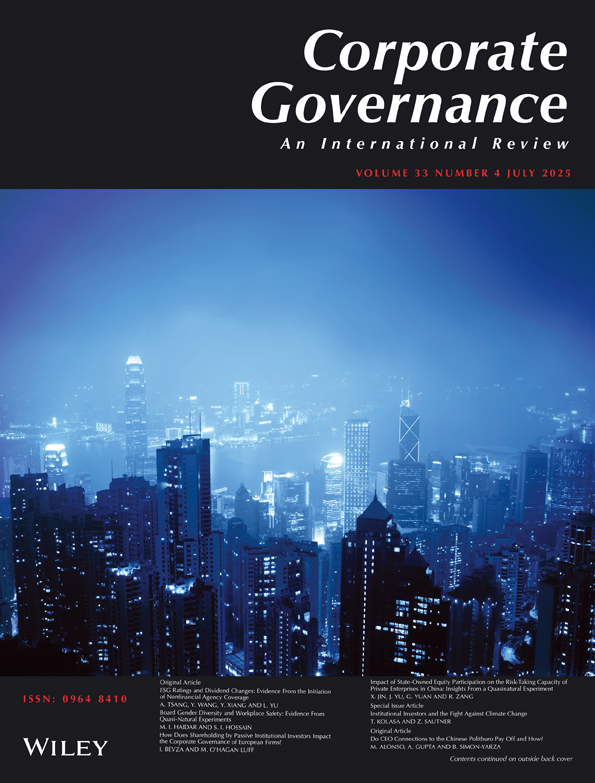
Bjuggren, P.-O., Nordström, L., & Palmberg, J. (2018). Are female leaders more efficient in family firms than in non-family firms? Corporate Governance: The International Journal of Business in Society, 18(2), 185–205
https://doi.org/10.1108/CG-01-2017-0017
What is Spotlight?
Spotlight is an innovative online family business magazine designed to bridge the gap between cutting-edge research and the real-world needs of practitioners, owners, and policymakers. Drawing on the latest findings from the Centre for Family Entrepreneurship and Ownership (CeFEO) at Jönköping International Business School, Spotlight delivers insightful, accessible summaries of key research topics. Our mission is to keep the family business community informed and empowered by offering actionable insights, expert analyses, and forward-thinking strategies that enhance business leadership and ownership practices for long-term success.

This article is brought to you by the WIFU Foundation
Spotlight is generously supported by the WIFU Foundation, which promotes research, education, and dialogue in the field of family business. This partnership enables us to continue bridging academic insights and real-world practice for the advancement of responsible family entrepreneurship and ownership.
CeFEO's Authors
CeFEO counts more than 50 scholars and 30 affiliated researchers. Several studies and reports have consistently identified CeFEO as a leading research environment worldwide in the area of ownership and family business studies. This research project, has been co-authored by the following CeFEO Members.
Reference
Spotlight highlights research-based findings only. If you’re interested in exploring this project further or delving into the theoretical and methodological details, we encourage you to contact the authors or read the full article for a comprehensive understanding.
Bjuggren, P.-O., Nordström, L., & Palmberg, J. (2018). Are female leaders more efficient in family firms than in non-family firms? Corporate Governance: The International Journal of Business in Society, 18(2), 185–205
https://doi.org/10.1108/CG-01-2017-0017
What is Spotlight?
Spotlight is an innovative, AI-powered, online family business magazine designed to bridge the gap between cutting-edge research and the real-world needs of practitioners, owners, and policymakers. Drawing on the latest findings from the Centre for Family Entrepreneurship and Ownership (CeFEO) at Jönköping International Business School, Spotlight delivers insightful, accessible summaries of key research topics. Our mission is to keep the family business community informed and empowered by offering actionable insights, expert analyses, and forward-thinking strategies that enhance business leadership and ownership practices for long-term success.
This article is brought to you by the WIFU Foundation
Spotlight is generously supported by the WIFU Foundation, which promotes research, education, and dialogue in the field of family business. This partnership enables us to continue bridging academic insights and real-world practice for the advancement of responsible family entrepreneurship and ownership.