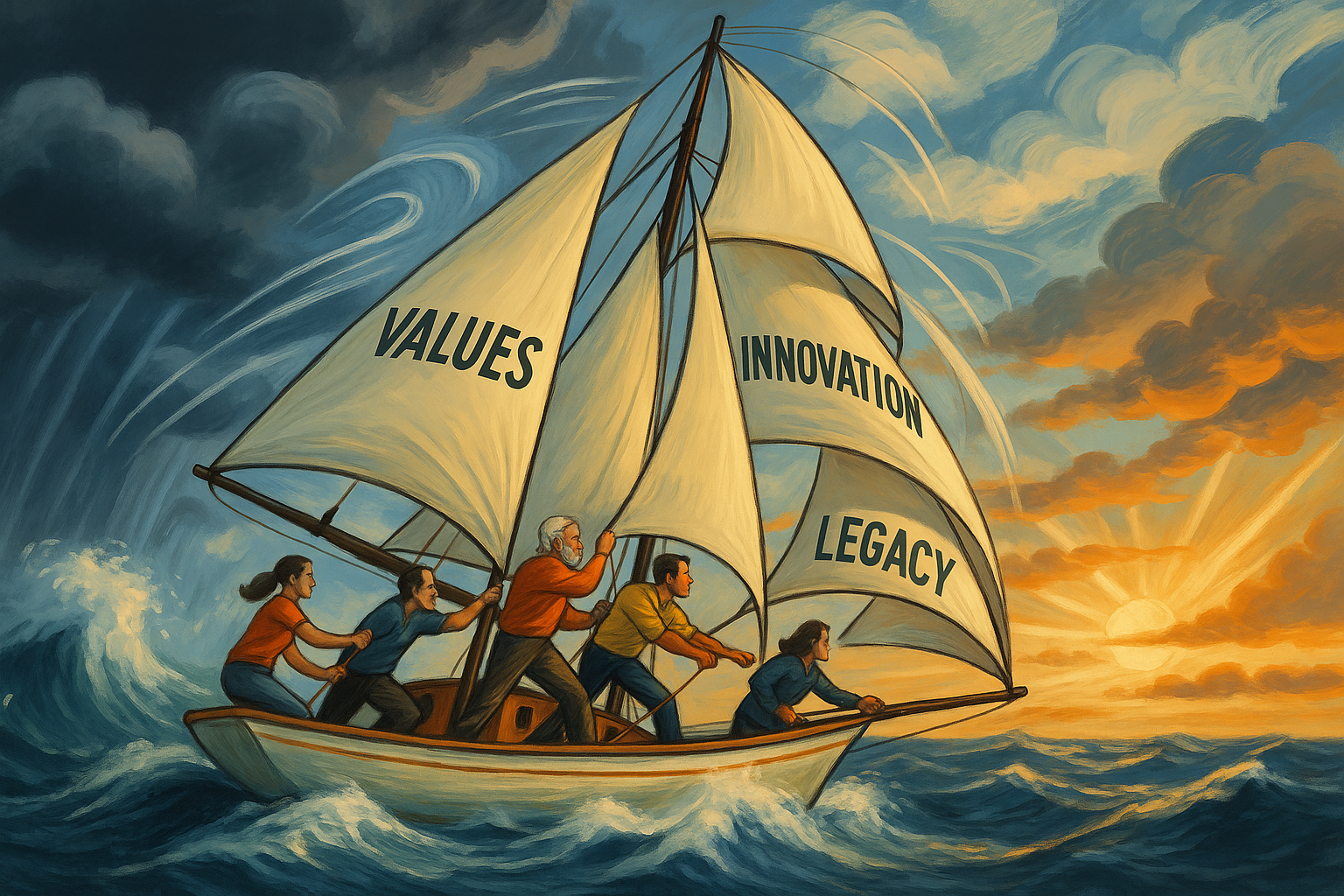
What happens when a family business must choose between survival and self-sacrifice?
Celina Smith; Mattias Nordqvist; Alfredo De Massis; Danny Miller
Audio > Play / StopNew research explains why family firms risk everything to protect legacy and control
When pushed to the edge, some family businesses escalate rather than surrender. This article introduces organizational brinkmanship—a pattern where family firms risk mutual destruction to protect legacy, control, and identity. Drawing on political science and socioemotional wealth theory, the authors map the path from compromise to confrontation, and explain why what looks like irrationality follows a deep emotional logic.
When pushed to the edge, some family businesses escalate rather than surrender. This article introduces organizational brinkmanship—a pattern where family firms risk mutual destruction to protect legacy, control, and identity. Drawing on political science and socioemotional wealth theory, the authors map the path from compromise to confrontation, and explain why what looks like irrationality follows a deep emotional logic.
Family businesses are often praised for patience and long-term thinking. That reputation is earned. But it obscures something important: when the things a family values most come under threat—control, legacy, identity, place—some family firms respond with startling aggression. They do not negotiate. They escalate. And they accept the possibility that the escalation could destroy them.
This article introduces the concept of organizational brinkmanship to family business research. Borrowed from Cold War political science, brinkmanship describes a strategy where a party pushes a confrontation to the edge of mutual destruction in order to force the other side to back down. Celina Smith, Mattias Nordqvist, Alfredo De Massis, and Danny Miller argue that this behavior is not random recklessness. It follows a logic rooted in the family’s emotional investments—what scholars call socioemotional wealth—and it can be understood, predicted, and managed.
What We Studied
This is a conceptual paper. The authors synthesize behavioral economics, crisis management theory, and family business research into a model that explains how brinkmanship emerges and escalates. They illustrate the framework with real cases: the Washington Post’s decision to publish the Pentagon Papers, a move that risked the family-controlled newspaper’s very existence, and Archway Sheet Metal’s legal battle against Aston Villa Football Club to resist a forced relocation from its historic site.
No hypotheses are tested. Instead, the paper builds a theory-driven framework by mapping the stages from threat perception through appeasement, escalation, and outcome. The goal is to equip both researchers and practitioners with a vocabulary for understanding why some family firms behave in ways that look, from the outside, like irrational self-destruction.
Key Insights
Threats are filtered through emotion, not spreadsheets
Family businesses do not process threats the way textbooks suggest. A forced relocation, a hostile takeover bid, or a regulatory change is never just a business problem. When the family’s name is on the building, when three generations have worked the same site, when the founder’s values are encoded in every decision—the threat becomes personal. The authors show that threat perception in family firms is shaped by emotional framing: what feels like an attack on identity will trigger a disproportionate response, even if the financial stakes are modest.
Legacy is the non-negotiable
The paper identifies three forms of attachment that make family firms willing to risk ruin: succession continuity across generations, place attachment to a physical site or community, and heritage longevity—the sense that decades or centuries of history are at stake. These bonds create emotional investments that can rival or exceed the financial ones. A family that has run a business for 150 years does not calculate the net present value of shutting down. The calculation is existential.
The escalation path: from compromise to confrontation
Brinkmanship does not begin with aggression. Family businesses are typically conservative. They prefer negotiation, compromise, even appeasement. The model traces a clear trajectory: the family first attempts to accommodate the threat. When appeasement fails, when feasible alternatives are exhausted, and when time pressure mounts, a psychological shift occurs. The firm moves from defense to offense. The authors call this the transition from rational calculation to emotional desperation—a state where the family is willing to accept shared danger rather than surrender what it values most.
Three preconditions must be met for brinkmanship to emerge: the family must be ready to risk losing control, must demonstrate visible commitment (through litigation, media campaigns, or public declarations), and must accept that its actions could hurt both itself and its adversary. This is what the authors call a "controlled loss of control." The language is paradoxical, but the phenomenon is real.
Outcomes leave an imprint
Win or lose, brinkmanship changes the family and the firm. Success may embolden the family to use the strategy again. Failure may lead to retreat, caution, or lasting trauma. The paper argues that the experience of brinkmanship shapes the family’s future risk appetite, governance structures, and willingness to engage with external stakeholders. One episode of brinkmanship can define a generation.
Takeaways
For family business owners
Know your emotional tripwires. What would push your family to take aggressive, potentially self-destructive action? Map these out before a crisis forces the question. Develop contingency plans that distinguish between what is negotiable and what is sacred—and be honest about the difference. Rehearse high-stakes scenarios with your leadership team and advisors so that emotional reactions do not drive strategy in the moment.
For advisors and board members
Non-family board members and external advisors are critical during escalation. They bring emotional distance. Their job in a brinkmanship scenario is to slow the process, introduce alternative framings, and prevent the family from conflating business survival with identity survival. Structured conflict-resolution forums within the family can also reduce the risk of internal disagreements amplifying external confrontations.
For the other side of the table
If you are negotiating with a family firm—as a regulator, competitor, or acquirer—understand that the family’s resistance may be rooted in something deeper than commercial interest. Pushing harder when you encounter brinkmanship behavior does not produce concessions. It produces escalation. Find out what the family is really protecting, and design proposals that respect those attachments.
Impact
Smith, Nordqvist, De Massis, and Miller open a genuinely new line of inquiry. Most family business research focuses on internal dynamics—succession, governance, identity. This paper turns the lens outward, asking what happens when a family firm confronts an external adversary under existential pressure. The brinkmanship framework gives researchers a structured way to study conflict escalation in family firms, and it gives practitioners a vocabulary for naming and managing a pattern of behavior that is widely recognized but rarely analyzed.
The paper also raises an uncomfortable question for the field: if emotional attachment to legacy can drive self-destructive behavior, how should governance structures account for that? Advisory boards, family councils, and succession plans all need to reckon with the possibility that the family’s deepest commitments may, under extreme pressure, become its greatest vulnerability.
Recommendations
- Investigate brinkmanship thresholds. Examine how personality traits, generational identity, and cultural context influence when families escalate from rational negotiation to emotional brinkmanship. Compare family and non-family firms in their conflict escalation patterns.
- Identify emotional tripwires early. Map the ownership group’s emotional pressure points before a crisis hits. Build relationships with potential adversaries during calm periods—trust is harder to establish once escalation begins.
- Use external governance as a buffer. Independent board members, professional mediators, and advisory councils can prevent emotional desperation from overriding strategic judgment during existential conflicts.
- Test the model empirically. Longitudinal case studies of family firms that faced existential threats—and how they navigated or failed to navigate brinkmanship dynamics—would advance this line of inquiry substantially.

CeFEO's Authors
CeFEO counts more than 50 scholars and 30 affiliated researchers. Several studies and reports have consistently identified CeFEO as a leading research environment worldwide in the area of ownership and family business studies.
This research project, has been co-authored by the following CeFEO Members.

Reference
Spotlight highlights research-based findings only. If you’re interested in exploring this project further or delving into the theoretical and methodological details, we encourage you to contact the authors or read the full article for a comprehensive understanding.

Smith, C., Nordqvist, M., De Massis, A., & Miller, D. (2021). When so much is at stake: Understanding organizational brinkmanship in family business. Journal of Family Business Strategy, 12, 100425.
https://doi.org/10.1016/j.jfbs.2021.100425
What is Spotlight?
Spotlight is an innovative online family business magazine designed to bridge the gap between cutting-edge research and the real-world needs of practitioners, owners, and policymakers. Drawing on the latest findings from the Centre for Family Entrepreneurship and Ownership (CeFEO) at Jönköping International Business School, Spotlight delivers insightful, accessible summaries of key research topics. Our mission is to keep the family business community informed and empowered by offering actionable insights, expert analyses, and forward-thinking strategies that enhance business leadership and ownership practices for long-term success.

This article is brought to you by the WIFU Foundation
Spotlight is generously supported by the WIFU Foundation, which promotes research, education, and dialogue in the field of family business. This partnership enables us to continue bridging academic insights and real-world practice for the advancement of responsible family entrepreneurship and ownership.
CeFEO's Authors
CeFEO counts more than 50 scholars and 30 affiliated researchers. Several studies and reports have consistently identified CeFEO as a leading research environment worldwide in the area of ownership and family business studies. This research project, has been co-authored by the following CeFEO Members.
Reference
Spotlight highlights research-based findings only. If you’re interested in exploring this project further or delving into the theoretical and methodological details, we encourage you to contact the authors or read the full article for a comprehensive understanding.
Smith, C., Nordqvist, M., De Massis, A., & Miller, D. (2021). When so much is at stake: Understanding organizational brinkmanship in family business. Journal of Family Business Strategy, 12, 100425.
https://doi.org/10.1016/j.jfbs.2021.100425
What is Spotlight?
Spotlight is an innovative, AI-powered, online family business magazine designed to bridge the gap between cutting-edge research and the real-world needs of practitioners, owners, and policymakers. Drawing on the latest findings from the Centre for Family Entrepreneurship and Ownership (CeFEO) at Jönköping International Business School, Spotlight delivers insightful, accessible summaries of key research topics. Our mission is to keep the family business community informed and empowered by offering actionable insights, expert analyses, and forward-thinking strategies that enhance business leadership and ownership practices for long-term success.
This article is brought to you by the WIFU Foundation
Spotlight is generously supported by the WIFU Foundation, which promotes research, education, and dialogue in the field of family business. This partnership enables us to continue bridging academic insights and real-world practice for the advancement of responsible family entrepreneurship and ownership.